
Save South Boulder
BACKGROUND
Below find a variety of informative videos and presentations which tell the story of the distrust that has built up as a result of the City of Boulder's choosing such an expensive and ineffectual design project for the exorbitantly overpriced dam. The cost estimates have risen 450% since the onset in 2016. With no citizen input or vote allowed, this may be Boulder's biggest boondoggle ever.
Impressive, FACTUAL presentatation outlining the uninformed polical decisions that led to the disaster we now call "CU South.."
Dam Design Flaws and Risks
The South Boulder Creek Floodplain: History, Uses, and Future
Steven Telleen, August 16, 2022 (Empower Hour Presentation)
Floodplains

Floodplains are critical for many terrestrial ecosystems, especially in arid regions like Colorado. In addition to the thousands of species of plants, animals, and fungi that live, feed, breed, and migrate through the varied riparian, wetland, and grassland communities that floodplains support, floodplains have sustained human hunting, gathering, and agriculture for tens of thousands of years.
The floodplain, itself, is a summary of the geologic history of the land. At the center we see the current path of the mainstem river or stream that created the floodplain. But the floodplain boundaries show us where that river or stream flowed in the past, and where it likely will flow again in the future.


The South Boulder Creek Floodplain is the largest undeveloped, continuous floodplain in Boulder County, and oneof the largest in the Front Range. The portion that makes up CU-South is located near the center of the floodplain and supports important populations of at least threeendangered or threatened species . . .
as well as providing permanent and migratory habitat for over 100 species of birds and many mammals, including humans and their canine friends.


The History of CU-South Land Ownership and Use
The Sustainable Economy
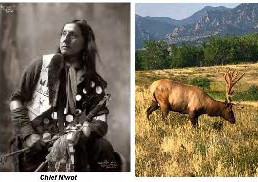
Prior to European settlement, the main Native American people utilizing the South Boulder Creek Floodplain were part of the Southern Arapahoe Nation. During the winter they used the natural resources of the floodplain in a sustainable manner until 1864 when, at Sand Creek, Colorado, the United States Calvary massacred many of these original stewards of the South Boulder Creek Floodplain. The area was subsequently taken over by European settlers.

These early European settlers also took advantage of the natural resources of the floodplain in a sustainable manner using the land for grazing. The portion of the floodplain that became CU-South was once used for grazing dairy cattle by the Van Vleet and Deepe families.
The Extraction Economy
This changed in 1952 when the Deepe family leased a portion of their land to the Flatiron Mining Company allowing them to extract sand and gravel from the floodplain. In 1972 the City of Boulder Greenbelt Committee unanimously agreed that the entire floodplain should remain open space, but did agree to accept mining under the reclamation conditions filed with the State Mining and Reclamation Board.
The Development Economy
In order to develop the property CU required water and sewer services from the City of Boulder. In
2001 the City offered to purchase the property for open space and flood mitigation at a “fair price.” CU responded by opening secret talks with the cities of Superior and Lafayette to obtain water and sewer services from one of them. However, these attempts failed because the US-36 Intergovernmental Agreement (IGA) specifies that only the City of Boulder can annex the property, leaving annexation to Boulder as their only option.
In 1978 the Van Vleet ranch was purchased in part by the City of Boulder for Open Space and in part by Flatiron Mining, bringing the acreage Flatiron Mining owned to the 308 acres of the floodplain now designated as CU-South. In 1981, 220 acres of the Flatiron Mining holdings were designated for future acquisition as Open Space in the Boulder Valley Comprehensive Plan.
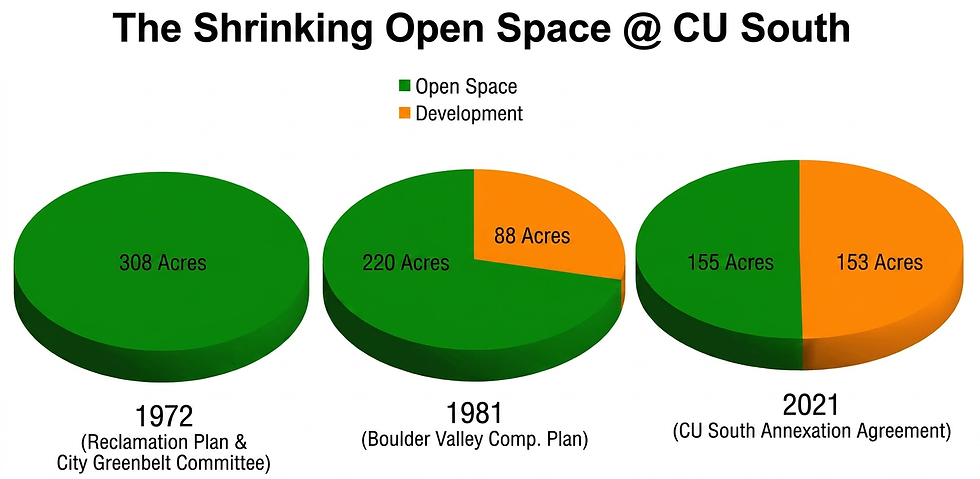
In 1995, when gravel operations were completed, CU entered into secret negotiations with Flatiron Mining to purchase the property. In 1996 the CU Regents approved the purchase. The Boulder City Council and Boulder County Commissioners unanimously passed a resolution to take all necessary actions to make sure CU followed the Boulder Valley Comprehensive Plan’s 220 acres as Open Space, and Governor Romer asked the Regents to respect Boulder’s Smart Growth Policy.
To summarize the history of this land for OpenSpace and flood mitigation, in 1972 the City Greenbelt Committee agreed the entire floodplain should remain open space. In 1981 the Boulder Valley Comprehensive Plan reduced this to 220 acres for future Open Space, leaving 88 acres as suitable for development. In 2021, by accepting the current agreement with CU, and their demand to develop 153 acres, the land for Open Space and flood mitigation was reduced to 155 acres. Virtually all of the 155 acres left for flood control and Open Space in the Annexation Agreement is in the South Boulder Creek floodplain and could not be developed in any event.

The History of Land Modification
From 1952 to 1995, the Flatiron Companies removed
4 million cubic yards of sand and gravel, lowering the mined area by 12-15 feet. To gain approval of their mining activities, they submitted a detailed reclamation plan showing how the land would be reclaimed when mining was complete. The plan consisted of large ponds and riparian areas that would attenuate South Boulder Creek floodwaters.

In 1996, immediately after CU purchased the property, instead of removing the levee, CU and the mine operators, without authorization, increased the height by 2-3 feet. Between 1998 and 2000 they made 3 requests for FEMA certification to make the “temporary” levee a permanent flood control structure. FEMA turned down these requests, but eventually the levee was certified

In 1997 CU, against strong objections from both the City of Boulder and Boulder County, lobbied the Colorado Mined Land Reclamation Board to gut the original flood-attenuating reclamation plan and revise the plan to accommodate maximum future development. Revisions included trucking in fill dirt, some used to eliminate 38 of the 42 acres of ponds on the property.
CU's revisions to the Reclamation Plan also allowed them to contour the property into a smooth bathtub-shaped channel that directed floodwaters toward the US-36 low spot, insuring the levee could not be removed safely.

In this photo, you can see the levee, and beyond that, South Boulder Creek as the more distant line of trees on the right side. The US-36-low spot under Table Mesa Drive is beyond the upper left corner of this picture.

Photos Courtesy of Ben Binder
In 2001, CU destroyed emerging wetlands and added underground aggregate drains in a dewatering effort to reduce the number of regulated wetland acres and make more land available for future development.
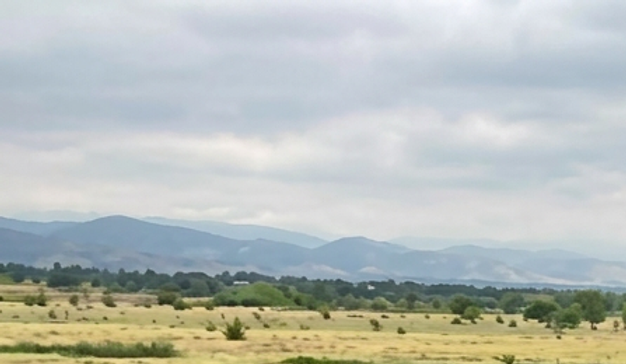
The above picture was taken in July, 2022 from the road on top of the, now permanent, levee seen in the contour picture above. You can see the southern portion of the levee in the distance on the right. This picture shows the natural recovery 25 years after being scraped clean by the contouring.

Left to its own natural recovery, in another25 years it would likely look more like the unmined habitat south of the levee.

During its operations, Flatiron Mining constructed what was only permitted as a “temporary” 6,000 foot levee to divert flood waters around the gravel pit during mining. The reclamation plan did not include this levee, which diverted the water onto neighboring properties and the northeast portion of their property along US-36. In 1995, rainstorms flooded the northern part of the property with 2-3 feet of water. In response, the property managers excavated a channel through a paved interior road to direct the water into Viele Channel, which opened a pathway to the US-36 low spot under Table Mesa Drive.
Also of increasing importance is the role wetlands play in mitigating climate change. Wetlands are particularly effective at sequestering carbon. Much more effective than manicured gardens and lawns and certainly more than asphalt and concrete.
In large floodplains, like South Boulder Creek, the mainstem is only the visible portion of the flowing water. Significant amounts of water continuously flow through the alluvium beneath the surface of the surrounding floodplain. This groundwater turns depressions into ponds, and sustains the wetland, grassland, and riparian communities that cover the surface.
After the Flood

Even in the FEMA Model 100-year zone the data show that only 21% of the overground flood damage was from the South Boulder Creek main channel. The remaining 79% was from local drainages that are not included in the proposed mitigation.
Source: Boulder Utility Department Report
A major local drainage is Viele Channel which runs between the proposed dam and the US-36 low spot under the Table Mesa Drive overpass. The South Boulder Creek main channel is behind the dam about one mile to the south. This means that in future floods Viele Channel floodwater will not be mitigated, and may be intensified, by the proposed dam.

Source: Boulder Utility Department Report

Even though damage in the South Boulder Creek drainage ranked fifth in the City overall and the mainstem only accounted for 21% of the overland water damage in the South Boulder Creek drainage, the City Council focused the majority of their effort on mitigating floodwaters in the eastern portion of South Boulder’s Frasier Meadows
Neighborhood along Foothill Parkway, the area flooded by the water that crossed
the US-36 low spot under Table Mesa Drive.
100-Year or 500-Year Mitigation: The Costs and Benefits
Following best practices, the City began with a cost/benefit analysis of mitigation options. The analysis showed a clear advantage for the 500-year mitigation both in the number of units protected and a lower cost per unit. The City Council adopted a goal to mitigate damage from a 500-Year Flood.

Why Did The Goal Change?
Since CU currently owns the modified land that channeled the mainstem floodwater toward the US-36
low spot, they became a significant player in the mitigation discussions, using the opportunity to justify
the annexation they had not been able to achieve before.

CU entered the mitigation discussions with two
non-negotiable demands. Their first demand was that the City annex the land and agree to provide CU with the water and sewer utilities they needed for development before any mitigation could begin. The second was that all mitigation plans leave CU with the specific 153 acres they wanted for development and sports fields. Ultimately, these conditions made 500-year flood mitigation infeasible. Rather than pursue other options for procuring the needed land, the City Council retreated to a 100-year flood mitigation goal, a goal that CU’s own climate and flood experts had deemed inadequate for decades.

The 2013 Flood

A number of streets and homes in South Boulder also experienced significant flooding. Of particularnote is the east side of the Frasier Meadows Neighborhood, from the low spot at US-36 along Foothills Parkway to Baseline.
In September, 2013 a wide-area, multi-day thunderstorm occurred along the Front Range with much of Boulder County, from Eldorado Springs to Lyons, experiencing severe flooding. This included most of the neighborhoods in the City of Boulder. There were two deaths directly related to the flooding, both in North Boulder.
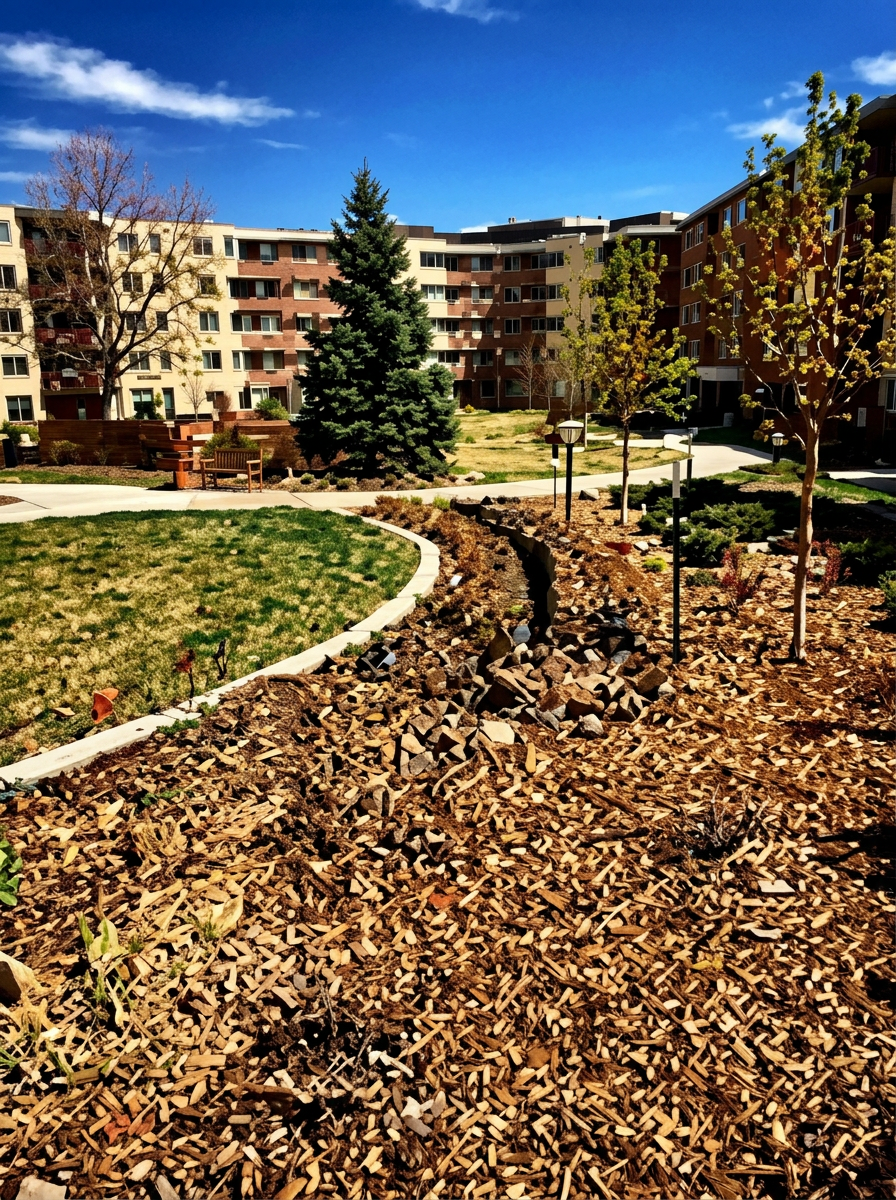
Since 2013 the Retirement Community has changed this area
significantly by adding berms, vegetation, and channeling the water
away from the buildings, as well as adding flood gates at the entrances
to their underground parking garages. If these local modifications had
been in place in 2013, the damage at that site likely would have been
greatly reduced.
While many streets and homes in the area, and elsewhere in South
Boulder, experienced significant flooding, residents on part of Qualla
Drive in East Frasier Meadows, a few streets away from the
Retirement Community, also were quite vocal in reporting traumatic
flooding experiences.

Why is This Important?

The Frasier Meadows Retirement Community experienced severe flooding in their underground parking garage and in first-floor apartments. Because these lower levels were below the surrounding ground level, the water was able to flow unimpeded into these levels of the buildings. This picturedepicts the 100-year flood map, not necessarily the actualarea flooded in 2013.
The City of Boulder mapped the extent of the flood area and compared it to the FEMA 100-Year Model Floodplain. The map shows that the flood water mostly overlapped the 100-year flood map, even though the South Boulder Creek mainstem flow levels
at the Eldorado Springs gage indicated that 2013 was a 70-Year Model Flood.
This is likely because the FEMA model is based on an intense 4 hour storm centered over Eldorado Canyon, but a 2005 review determined the model was highly sensitive to the location of the storm center. A storm centered over tributary basins further north would produce 20-40 times the flows predicted by the Model Storm and likely cause more property damage than the mainstem floodwater. The multi-day, widespread storm Boulder experienced in 2013 flooded these tributary basins in addition to the mainstem headwaters.
The City of Boulder Utilities Division also conducted a Flood Impact Survey and Analysis, published
in 2014, which combined their own loss survey data with insurance claims data from FEMA.
The data supported the model sensitivity to the storm location. Their data documented that 44% of the damage in the South Boulder Creek drainage was in the FEMA designated 500-year flood zone. This is significant as the City is only proposing mitigation for a 100-year Model Flood event, and based on the FEMA Model Flood, the 2013 flood was only a 70-Year event,
while much of the loss was in the 500-year zone.

The City is currently pursuing an extremely expensive project that will provide very limited flood protection for the East Frasier Meadows Neighborhood.
But the certain and potential costs are not confined to the increased utility bills everyone who lives in Boulder will face.

Source: Boulder Utility Department Report

Finally, the proposed floodwall requires an impermeable barrier to bedrock that will block the floodplain groundwater flowing from CU South on the southwest side of US-36 into the Open Space and Colorado Natural Area land to the northeast. This is where key populations of the endangered and threatened species in Boulder County live.
The proposed conveyance system to minimize groundwater disruption has never been tested for a use like this and has several potential points of failure. If this theoretical workaround does not perform as planned both now, and in the future, the
disruption to the groundwater flow risks permanent destruction of hundreds of acres of sensitive habitat in the floodplain Open Space and State Natural Area on both sides of US-36, again, with no Plan-B.
Summary
Floodplains sustain an incredible diversity of life and their wetlands help reduce flooding and cool the planet
Changes made to the floodplain in pursuit of unsustainable extraction and development economies
can cause or intensify flooding in adjacent areas and neighborhoods and destroy critical habitat in others
Obsession with status and success keeps us from listening:
Listening to nature and the land onwhich we depend,
Listening to the science that warns us of our limitations and fallacies, and
Listening to the commitments made to our fellow and future earth-mates.
Commitments we struggle to honor or break with each decision and action we choose, right here, right now.

For more information visit:
Select this paragraph to add your own text. Just drag and drop or click here to add this paragraph to your site, then you can add your own content and make changes to the font.